Components of a Garage Door
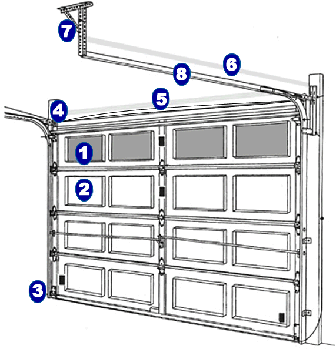
1 Window Lite Glazed section with various types of glass
or clear acrylic to allow for light and visibility.
2 Sections Panels reinforced with stiles interconnected
with hinges and rollers.
3 Bottom Bracket A structured support which provides for
attachment of lifting cables.
4 Cable Drum Grooved drums on the torsion spring shaft
that lifting cables wind around when door is opening.
5 Torsion Spring Provides the means to raise and lower
the garage door via cable winding on drums.
6 Extension Spring Garage doors either use extension or
Torsion springs. Extension springs extend along both
horizontal tracks.
7 Rear Track Hanger
8 Track Provides a guide for section to raise or lower the
garage door.
1 Window Lite Glazed section with various types of glass
or clear acrylic to allow for light and visibility.
2 Sections Panels reinforced with stiles interconnected
with hinges and rollers.
3 Bottom Bracket A structured support which provides for
attachment of lifting cables.
4 Cable Drum Grooved drums on the torsion spring shaft
that lifting cables wind around when door is opening.
5 Torsion Spring Provides the means to raise and lower
the garage door via cable winding on drums.
6 Extension Spring Garage doors either use extension or
Torsion springs. Extension springs extend along both
horizontal tracks.
7 Rear Track Hanger
8 Track Provides a guide for section to raise or lower the
garage door.

How to Measure your Garage Door
Step #1 Measure door opening width and height
in feet and inches. This determines the size of
door needed. The rough opening should be the
same as the size of the door.
Step #2 Measure for side room: 3-3/4" is required
on each side for installation of the vertical track
for standard extension spring or standard torsion
spring.
Step #3 Measure area labeled "headroom" -
distance between the top of the door opening and
the ceiling.
Step #4 Measure area labeled "back room" -
distance is measured from the garage door
opening towards the back wall of the garage.
Door hight plus 18" is required. Additional back
room may be required for installation of automatic
garage door opener.
Step #1 Measure door opening width and height
in feet and inches. This determines the size of
door needed. The rough opening should be the
same as the size of the door.
Step #2 Measure for side room: 3-3/4" is required
on each side for installation of the vertical track
for standard extension spring or standard torsion
spring.
Step #3 Measure area labeled "headroom" -
distance between the top of the door opening and
the ceiling.
Step #4 Measure area labeled "back room" -
distance is measured from the garage door
opening towards the back wall of the garage.
Door hight plus 18" is required. Additional back
room may be required for installation of automatic
garage door opener.
General Safety Information
Garage Door System Safety
A garage door is the largest moving object in the home. They are often operated by electric door
openers. Proper installation, operation and maintenance and testing of the garage door and
automatic opener are necessary to provide safe, trouble-free operation. An improperly adjusted
garage door or automatic opener can exert deadly force when the door closes. This could lead to serious injury
or death from being hit by a closing garage door or from being trapped under the door.
Safety is Everyone's Business
A few simple precautions can protect your family from potential harm. Please take a few moments to read the
following safety and maintenance tips. Refer to your garage door and opener owner's manual for details specific to
the model you own. Then check the operation of your garage door and automatic opener.
Garage Door Openers Are Not Toys
Do not stand or walk under a moving door! Do not let children or adults play "beat the door". It
is dangerous and can result in serious injury or death. Adults should set a good example.
Know how to use the emergency release, in case someone is pinned by the door. Do not let
children play with or use the transmitters or remote controls. Always place and store them out of
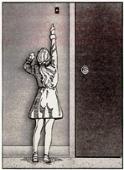
the reach of children. The pushbutton wall control should be out of reach of children (at least 5
feet from the floor) and away from all moving parts. Mount and use the button where you can
clearly see the moving garage door.
Teach Your Children About Garage Door and Opener Safety
Garage door openers are not toys. Careless operation and allowing children to play with or use
garage door opener controls can lead to tragic results. Discuss garage door safety with your
children. Explain the danger of being trapped under the door.
When using the pushbutton or transmitter, keep the door in sight until it completely stops moving. Teach children
never to play under or near an open garage door.
Teach children to keep their hands and fingers clear of section joints, hinges, track, springs and other door parts.
Contract with a moving door or its hardware could cause injury. These injuries can also happen when garage doors
that do not have automatic openers.


__________________________________________________________________
 |
| |
 |
| |
 |
| |
 |
| |
 |
| |
 |
| |
 |
| |
 |
| |
 |
| |
 |
| |
 |
EDUCATE YOURSELF:
Click here for a kids coloring page - please talk to your children about the safety of garage doors!
| Garage Door Installation (Steel, Vinyl, Wood, Carriage House), Door Repairs, Section Replacement, Spring Repair, Track Repair, Garage Door Opener Repair, Keypads, Remotes - Liftmaster & Genie Openers 80 Rowe Ave 2B, Milford, CT 06461 doorsolutionsllc@sbcglobal.net 203-874-0844 877-669-0500 |
CT License #: 0603837


Find us on: